 Jeremy
 Understanding Edge AI in the Context of Warehouse Robotics
Warehouse automation is evolving rapidly, fueled by advances in artificial intelligence, robotics, and the Industrial Internet of Things (IIoT). One of the most transformative technologies gaining traction is Edge AI. But what exactly is Edge AI, and how does it impact warehouse robots?
Edge AI refers to the execution of artificial intelligence algorithms directly on local hardware devices—at the “edge” of the network—rather than in centralized cloud servers. In the context of warehouse robotics, Edge AI allows robots to process data and make decisions in real time, on-site, without relying on a constant cloud connection. This significantly reduces latency and enables faster, more autonomous operations.
Why Real-Time Decision Making Is Critical in Warehousing
Warehouses are dynamic environments where hundreds—if not thousands—of operations happen simultaneously. From picking and packing to inventory checks and order fulfillment, the need for rapid, on-the-spot decision-making is crucial. Delays can result in workflow bottlenecks, safety risks, and lower overall efficiency.
Edge AI plays a vital role by enabling robots to:
- Identify obstacles and navigate around them instantly
- Recognize and categorize products using image recognition
- Detect anomalies such as misplaced goods or damaged packages
- Optimize routes dynamically based on traffic and workflow conditions
All of these capabilities contribute to faster throughput, reduced error rates, and more resilient supply chain operations.
How Edge AI Enhances Autonomous Mobile Robots (AMRs)
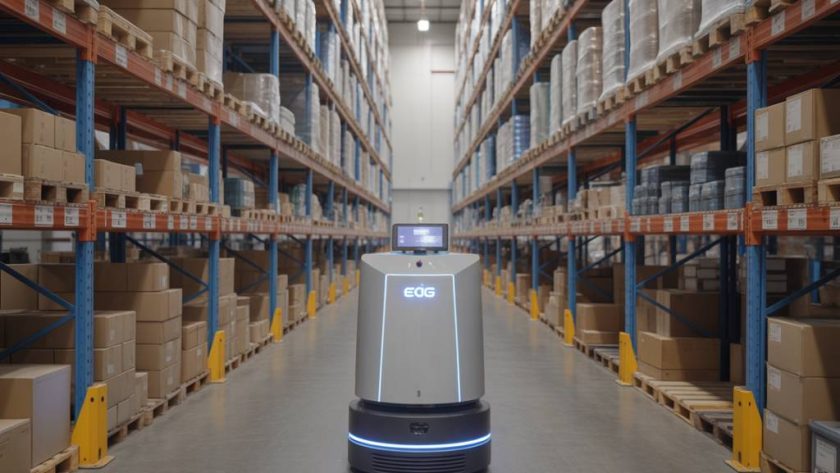
Autonomous Mobile Robots (AMRs) are increasingly deployed in warehouses to handle picking, transporting, and sorting tasks. Traditionally, these robots would rely on a central command or cloud-based system to process data. However, this setup often created latency issues and required a reliable internet connection.
With Edge AI, AMRs are now equipped with embedded processing units—often powered by chipsets like NVIDIA Jetson or Intel Movidius—allowing them to interpret sensor data, make contextual decisions, and adapt their behavior on the fly.
This means that if an AMR encounters a blocked aisle, it can instantly recalculate its route without needing to “ask” a central server. Similarly, Edge AI lets robots recognize unique items using onboard cameras and computer vision models, thereby improving picking accuracy and reducing reliance on pre-coded SKU lists.
Edge AI vs Cloud AI in Warehouse Settings
It’s important to distinguish between Edge AI and traditional cloud-based AI. Each has its place, but in high-speed environments like warehouses, Edge AI offers several distinct advantages:
- Low Latency: Processing data locally eliminates round-trip times to remote servers.
- Network Resilience: Edge AI continues functioning even during network outages or disruptions.
- Data Privacy: Sensitive information remains on-site rather than being transmitted over the internet.
- Scalability: Organizations can deploy more robots without overwhelming centralized systems.
Cloud AI remains useful for aggregating data across warehouses, training large-scale models, or performing long-range analytics. However, the trend in smart warehousing is clearly shifting toward hybrid models, where Edge AI handles operational decision-making, and the cloud provides strategic oversight.
Key Components of an Edge AI-Enabled Robot
Deploying Edge AI in warehouse robotics involves both hardware and software components. Key elements typically include:
- Onboard Processing Units: Specialized chips for AI inference, such as ARM Cortex processors or AI accelerators.
- Sensor Suites: LiDAR, 2D/3D cameras, IMUs, and ultrasonic sensors for environmental awareness.
- Machine Learning Models: Pretrained or re-trainable algorithms for object detection, path planning, and fault prediction.
- Software Frameworks: Edge-oriented platforms like EdgeX Foundry, ROS2, or NVIDIA Isaac SDK.
Together, these components allow warehouse robots to be far more than just remote-controlled machines—they become intelligent agents capable of independent action.
Use Cases: Edge AI Driving Real-World Warehouse Efficiencies
Several industry leaders have already embraced Edge AI across their warehouse operations. Here are a few real-world applications:
- Predictive Maintenance: Edge AI monitors robot components in real time, detecting wear or overheating before breakdowns occur.
- Inventory Accuracy: AI-enabled vision systems onboard drones or robots scan shelves and reconcile digital inventory logs more effectively than manual audits.
- Workforce Collaboration: Robots equipped with Edge AI can detect human co-workers’ presence, ensuring safe and seamless interaction in shared workspaces.
- Energy Optimization: AI evaluates traffic patterns and job urgency to reduce idle times and optimize charging schedules for robot fleets.
These applications demonstrate the tangible return on investment businesses can expect when integrating Edge AI into their warehouse automation strategies.
Challenges and Considerations in Edge AI Implementation
Despite its benefits, Edge AI also brings certain technical and operational challenges:
- Hardware Constraints: Computation at the edge is limited by power consumption and heat dissipation requirements in mobile devices.
- Model Accuracy: Because Edge AI devices have less computing power, models must be lightweight, risking loss in precision.
- Maintenance Complexity: Managing updates, firmware patches, and model tuning across a distributed fleet can be resource intensive.
- Cybersecurity: Local AI systems must be protected from tampering, requiring robust device-level security protocols.
A carefully designed architecture can mitigate many of these risks. Edge AI is not a plug-and-play solution; it demands investment in skills, tools, and long-term systems thinking.
The Future of Supply Chain Automation with Edge AI
As the supply chain becomes increasingly digital and interconnected, the push for faster, smarter, and more autonomous operations will accelerate. Edge AI is positioned as a cornerstone of this evolution, enabling warehouse robots to operate with unprecedented autonomy, responsiveness, and efficiency.
With advancements in semiconductor design, 5G connectivity, and federated learning, the potential of Edge AI for warehouse robotics will only expand. Enterprises that adopt this technology now are not just solving today’s challenges—they’re building a foundation for the next generation of agile, intelligent supply chain systems.
Whether you’re looking to improve picking accuracy, reduce downtime, or scale your robotics fleet, Edge AI offers a powerful path forward. Its ability to bring real-time decision-making to the warehouse floor marks a paradigm shift in operational intelligence and performance.